🥖 Staple vs. Treat: The Humanities of Global Bakery Culture
Comparative Analysis of East vs. West
1. History & Origin: Tool for Survival vs. Sweet Luxury
The perspective on bread varies drastically across continents. In Europe, bread has been synonymous with **'Survival'** and the **'Table'** itself for thousands of years. Originating in Ancient Egypt and spreading through the Roman Empire, bread symbolized the "Body of Christ" religiously and served as a measure of social class. The fact that the French Revolution was sparked by soaring bread prices proves the absolute weight bread holds in Western history. France's 1993 'Bread Decree (Décret Pain)', regulating baguette quality by law, is an effort to protect national identity beyond mere food preservation.
Conversely, in East Asia (Korea, Japan, China), where rice is the staple, bread was accepted as a product of modernization and a **'Preference Item' (Treat)**. Introduced via missionaries or military in the late 19th century, bread developed as a type of Western confection (snack) enjoyed with tea rather than a meal. Consequently, Eastern baking technology evolved not towards the blandness suitable for replacing rice, but towards utilizing red bean paste, cream, and sugar to supplement calories and provide gastronomic pleasure.
2. Ingredient Science: The Critical Difference Between Lean & Rich Dough
The difference between Eastern and Western bread is most evident in the formula. Technically, this is distinguished as **'Lean Dough'** versus **'Rich Dough'**.
🍞 West: The Aesthetics of Lean Dough (Water, Salt, Flour, Yeast)
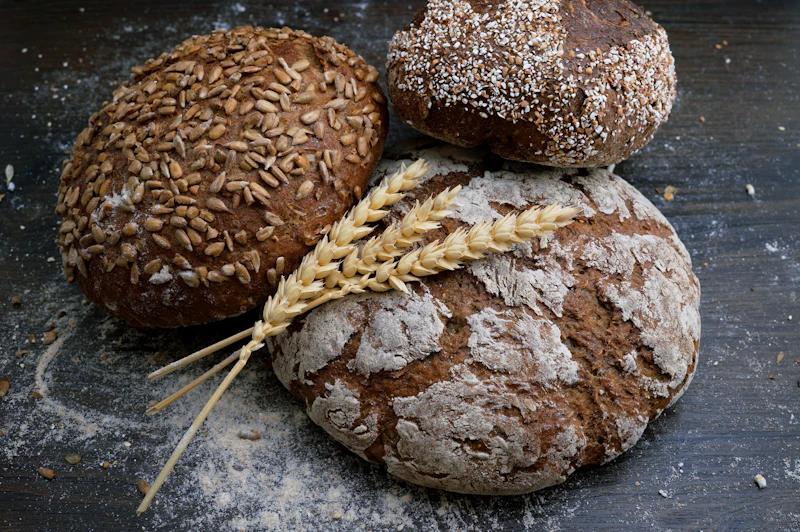
Western meal breads like Baguettes, Ciabatta, and Sourdough contain almost no dairy fat or sugar. Instead, they rely on the magic of **'Fermentation'**. Long-term low-temperature fermentation breaks down starch in flour, bringing out natural sweetness and umami. Baked at high temperatures, they feature a crust crispy like scorched rice and a crumb with large air pockets and chewiness. This structure is optimized for dipping in soups or sauces.
🥯 East: The Softness of Rich Dough (Sugar, Butter, Eggs, Milk)
Eastern breads like Red Bean Bread, Soboro, and Melon Pan incorporate significant amounts of sugar, butter, and eggs from the mixing stage. While these ingredients hinder gluten formation, they delay staling and create a soft, cake-like texture. Notably, the Japanese **'Tangzhong (Water Roux)'** method—gelatinizing flour with hot water before adding it to the dough—perfected the chewy, moist texture unique to Eastern breads.
| Comparison | West (Meal Bread) | East (Snack Bread) |
|---|---|---|
| Key Ingredients | Flour, Water, Salt, Yeast | Flour + Sugar, Butter, Eggs |
| Fermentation | Natural Sourdough, Long-term | Commercial Yeast, Short-term |
| Crust | Thick, Crispy (Hard) | Thin, Soft |
3. Fusion Recipe: The Perfect 'Crack Salt Bread' (Shio Pan)
A hybrid menu that perfectly combines the Western crispy crust (Lean) with Eastern butter flavor (Rich). The key is that the butter melts during baking, frying the bottom to a crisp and creating a hollow 'butter cave' inside.
🥣 Ingredients (Makes 8)
- Dough: 200g Bread Flour, 50g Cake Flour (for crispiness), 160g Water, 8g Milk Powder, 15g Sugar, 5g Salt, 4g Yeast, 15g Unsalted Butter
- Filling (Key): 80g Cold Salted Butter stick (8 pieces of 10g each)
- Topping: Pearl Salt or Coarse Sea Salt
👨🍳 Baking Process
- Gluten 80%: Mix dough ingredients and knead until smooth. Don't over-knead. (1st Rise: 50 mins)
- Cone Shape: Degas and divide into 8 parts. Shape into long 'carrot (cone)' shapes and rest for 15 mins. This ensures a beautiful roll.
- Butter Roll: Roll the dough out long (approx. 30cm). Place a cold salted butter stick on the wide end and roll it up tight. Pinch the seams well.
- Proof & Top: After 2nd Rise (40 mins), mist lightly with water and sprinkle pearl salt.
- High Heat Bake: Bake at 210°C (410°F) in a preheated oven for 12-14 mins. It's normal for butter to leak out and sizzle on the pan.
4. 2026 Trends: The Blurring of Bakery Borders
The global bakery trend for 2026 is 'East-West Crossover'. Health-conscious Eastern consumers are enthusiastic about 'European Meal Breads' using whole grains and less sugar. The fact that Jambon Beurre (Baguette Sandwich) or Ciabatta sandwiches have become daily staples in Korean cafes is proof of this.
Conversely, Western gourmets are paying attention to Eastern 'Soft Bread'. Instead of hard baguettes, the soft and rich flavors of Japanese 'Shokupan' or Korean 'Garlic Bread' are taking over hip bakeries in the US and Europe. Bread is now evolving beyond the boundaries of staple and snack into a new gastronomic experience combining the food cultures of each nation.
